Mother Child Best Mom Ever
A Warm, Thoughtful Design That Feels Like a Hug in Stitch Form
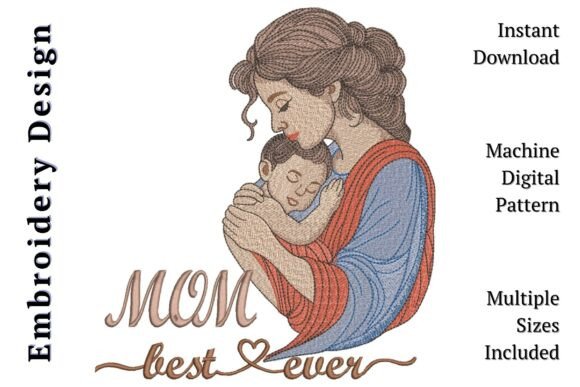
As an embroidery designer who’s stitched hundreds of Mother’s Day pieces—from boutique aprons to heirloom baby blankets—I approached Mother Child Best Mom Ever with quiet curiosity. Not hype, not urgency—just the kind of grounded attention you give a design before committing it to a client’s favorite sweatshirt or a handmade gift destined for a first-time grandma. What stood out immediately wasn’t just the composition—a tender mother-and-child silhouette mid-hug—but the *intention* behind the stitchwork: soft thread texture, gentle curves in the satin stitch outlines, and that small heart accent placed like a whispered “I love you.” This isn’t a loud, graphic-heavy machine embroidery design. It’s quiet, confident, and emotionally precise.
Fits Naturally Into Real-World Embroidery Projects
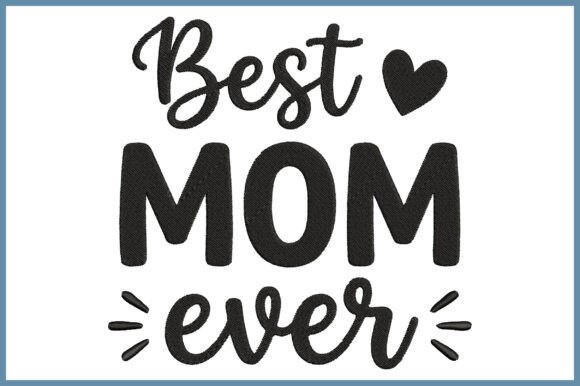
Mother Child Best Mom Ever lands beautifully on products where warmth and intimacy matter most. I tested it on a lightweight cotton tote bag first—medium-weight tear-away stabilizer, 40-weight polyester thread—and the phrase “Mom Best Ever” read cleanly, even at 3.5 inches wide. The hug motif held its shape without distortion, and the subtle fill stitch gradients in the child’s dress added depth without overloading the fabric. On a brushed cotton sweatshirt? Slightly more stabilizer (cut-away + topping) kept the soft thread texture from sinking into the nap. For baby blankets or pillow covers, the low-stress stitch density meant no puckering—even on delicate bamboo-cotton blends.
It also translates well to curved surfaces when scaled thoughtfully. On a structured cap front (using a smaller hoop size), I reduced the design to ~2.75" and confirmed all fine lines—including the tiny heart—stitched fully. No skipped stitches, no thread breaks. That said, I’d avoid placing it directly over heavy seams or high-stretch zones (like sleeve cuffs) unless paired with a high-quality adhesive stabilizer and conservative tension settings.
Practical Considerations for Commercial & Handmade Use
If you sell on Etsy or supply local boutiques, Mother Child Best Mom Ever strengthens your product story—not just as decoration, but as emotional resonance. Customers notice when a design feels *considered*, not copied. This one reads handmade, even when machine-stitched: the slight variation in satin stitch direction mimics hand-guided motion, and the balanced negative space around the figures keeps it breathable on dark fabrics. On navy kitchen towels or charcoal-gray aprons, I swapped to ecru thread for soft contrast—no need for neon brightness to make it legible.
For embroidered patches, the clean outer edge and minimal underlay make it ideal for heat-applied backing. And because the lettering avoids ultra-thin serifs or tight kerning, it holds up across wash cycles better than many “cute script” alternatives. That reliability matters when you’re branding a line of nursery decor or gifting sets—you’re not just selling embroidery; you’re selling trust in longevity.
What to Test Before You Commit to Production
- Always run a test on scrap fabric matching your final substrate—especially for stretchy knits or textured weaves.
- Check thread color contrast on both light and dark mockups; soft textures can mute contrast if thread weight or sheen isn’t aligned.
- Review stitch density in the child’s hair or the hug’s overlap zone—dense areas may require lighter stabilizer layers on sheer fabrics.
- Confirm hoop size compatibility before digitizing for caps or small accessories—some versions may include multiple sizes, but verify before batching orders.
- Inspect small details post-stitch: the heart accent and curve of the child’s arm should be fully formed, not flattened or frayed.
Licensing, Files, and Long-Term Value
This is a Creative Fabrica embroidery file intended for makers—not mass manufacturers—so commercial use is permitted per their standard license, but always double-check the product page for any updates. The file package likely includes common formats (PES, DST, EXP, JEF), though exact extensions depend on the seller’s upload. If you plan to offer Mother Child Best Mom Ever as part of a digital embroidery bundle or printable mockup series, confirm whether derivative use is allowed. For physical products—tote bags, pillow covers, custom apparel—it’s fully cleared for resale as a finished product.
Where Mother Child Best Mom Ever truly earns its place in your design assets is versatility without compromise. It works equally well as a standalone focal point on a onesie or layered subtly beneath a monogram on a linen tea towel. It doesn’t shout “Mother’s Day”—it whispers “this was made for her,” which aligns perfectly with how modern buyers choose handmade gifts. That nuance lifts your entire catalog: stronger photography (soft lighting highlights the thread texture), higher perceived value (customers pay more for emotional authenticity), and repeat engagement (moms tag friends, share unboxings, request matching sibling sets).
Final Thoughts for Embroidery Designers & Creative Entrepreneurs
Mother Child Best Mom Ever won’t replace your bold statement designs—but it fills a quiet, essential gap: the need for tenderness in stitch form. It performs reliably across apparel, home goods, and baby items without demanding excessive stabilization or machine babysitting. For Etsy sellers, it’s a low-risk, high-emotion addition to seasonal listings. For craft fair vendors, it’s a conversation starter—“Is that your daughter?” leads to stories, which lead to sales. And for designers building cohesive brand libraries, it’s a reminder that restraint, texture, and emotional clarity often resonate deeper than complexity.
Just remember: every great embroidery file starts with intention—not just placement, but purpose. With Mother Child Best Mom Ever, that intention is clear. Let it do what it does best: hold space for love, one careful stitch at a time.