Primitive Crow and Pear Family Embroidery
First Impression: Rustic Charm with Heartfelt Warmth
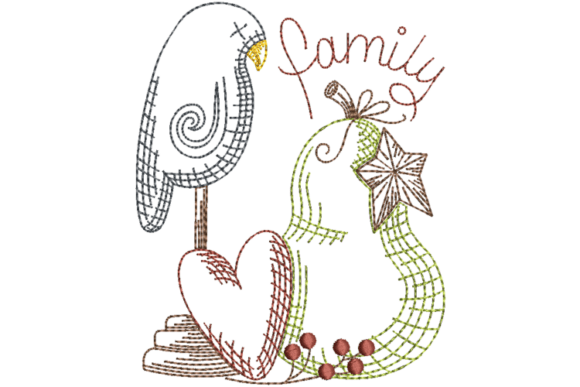
As an embroidery designer who’s prepped over 200 craft fair booths, my gut reaction to Primitive Crow and Pear Family Embroidery is immediate: this is a mood-maker. It reads as warmly rustic—not fussy, not trendy, but deeply grounded in farmhouse soul and handmade sincerity. The primitive-style crow suggests quiet confidence; the checked pear nods to vintage kitchen charm; the patched heart and stitched star whisper “made with care.” And “family” in curly script? That’s the emotional anchor. It doesn’t shout—it invites. At a crowded market, where bold graphics and neon fonts compete for attention, this design stands out by leaning *into* softness, nostalgia, and intentionality.
Where It Shines: Craft Fair-Ready Product Pairings
Tote bags: A natural home. The composition balances well across the center panel—neither too tall nor too wide—so it reads clearly even when folded or slung over a shoulder. As a craft fair product, it signals warmth before a word is spoken.
Aprons and tea towel embroidery: This design thrives on functional textiles. On a linen-cotton apron, the primitive bird and pear gain tactile authenticity. On a flour-sack tea towel, the checked pear and stitched star pop against subtle texture—no competing pattern needed. Customers consistently pause longer at aprons and towels that feel like heirlooms-in-the-making.
Embroidered patches and fabric pouches: Here’s where Primitive Crow and Pear Family Embroidery proves versatile. As a patch, it adds instant character to denim jackets or canvas totes—ideal for Etsy sellers offering customization. On a small drawstring pouch (think gift wrap or jewelry storage), it becomes a quiet signature of quality.
Pillow covers and market bags: Scale matters—and this design scales beautifully. At 4–5 inches wide, it holds presence without overwhelming. On a neutral linen pillow cover, it reads as boutique-level detail. On a heavyweight canvas market bag, it feels substantial and intentional—not an afterthought.
What Makes It Sell: Clarity, Consistency, and Emotional Hook
This isn’t just another machine embroidery design. It’s a storytelling tool. At a glance, shoppers grasp its theme: home, family, handmade care. No decoding required. That clarity is gold at a craft fair—where decisions happen in seconds. It also photographs exceptionally well for Etsy listings and social previews: soft shadows, balanced negative space, and clear stitch definition translate directly to strong printable mockups.
For batch production? Highly repeatable. The elements are distinct but cohesive—no overlapping fine lines or micro-details that fray under speed. As a digital embroidery file, it lends itself to consistent output across fabrics and machines, supporting brand consistency for small shop owners building a recognizable line.
Careful-Use Notes: Protecting Its Quiet Power
Don’t rush into production without testing. Primitive details—like the “patched” heart or fine star stitching—can blur on thick, napped fabrics (think heavy twill caps or terry cloth towels). On dark fabric, confirm thread contrast: light ecru or oatmeal threads may vanish unless paired with tonal metallic or high-contrast tan.
That curly “family” lettering? Beautiful—but delicate. Below 2.5 inches wide, legibility softens. Avoid shrinking it onto tiny keychains or narrow ribbon tags. Likewise, curved surfaces (like structured cap fronts) demand careful hooping and stabilizer choice—use cutaway + topping for crispness.
Stitch density is likely moderate (given the primitive aesthetic), but always inspect the embroidery file for dense fill areas around the pear’s check or heart’s patch seams. Over-stuffing those zones on textured towels can cause puckering—or worse, skipped stitches during high-volume runs.
Booth Impact & Buyer Engagement
In person, Primitive Crow and Pear Family Embroidery elevates perceived value instantly. A simple tea towel with this motif reads more premium than one with generic florals—because it feels curated, not mass-produced. When displayed alongside matching embroidered pouches and a framed sample on burlap, it builds a mini-world customers want to step into.
I’ve watched buyers linger, touch the texture of a patched-heart stitch, then ask, “Is this all hand-done?” Even when machine-embroidered, the primitive style cues handmade integrity. That trust translates directly to conversion—especially among shoppers seeking meaningful handmade products over decor-by-algorithm.
Designer-to-Designer Production Checklist
- Test the embroidery file on scrap fabric matching your final product (e.g., unbleached linen for tea towels, midweight cotton for totes).
- Verify thread colors against your base fabric—especially for the pear’s check and star’s outline.
- Review spacing between elements: does the crow’s wing clear the pear? Does “family” sit comfortably above the heart?
- Confirm hoop size compatibility—avoid designs requiring oversized hoops unless your machine supports them reliably.
- Inspect stitch density in critical zones (heart patch, star points, letter terminals) and adjust underlay if needed.
- Choose stabilizer intentionally: cutaway for stretchy knits, tear-away for stable wovens, topping for textured towels.
- Create at least one real-life mockup—not just digital—and photograph it in natural light.
- Compare how it reads across fabric colors: ivory, charcoal, oat, and navy each change emotional tone.
- Before selling finished products, confirm commercial licensing applies to your use case—especially for wholesale or bundled kits.
Final Thought: A Quiet Anchor in a Noisy Market
In a landscape saturated with fast trends and algorithm-driven aesthetics, Primitive Crow and Pear Family Embroidery is a grounding force. It doesn’t chase attention—it earns it. For embroidery business owners, Etsy sellers, and boutique makers, it’s more than a bird embroidery design. It’s a values-aligned asset: warm, timeless, production-smart, and emotionally resonant. Launch it right—with thoughtful fabric pairings, tested execution, and authentic storytelling—and watch it become a quiet bestseller at your next craft fair.