Smile Script: A Boutique Sweatshirt Designer’s Honest Review
As an embroidery designer who’s developed over 200+ designs for small clothing brands and Etsy sellers, I approached Smile Script with quiet curiosity—not hype. This isn’t another generic script font bundled with clipart; it’s positioned as an Inspirational Embroidery piece meant to land softly but meaningfully on premium apparel. So when our boutique prepared a limited drop of neutral-toned sweatshirts and oversized hoodies, Smile Script was the first design we pulled for real-world testing.
First Impression: Light, Lively, and Intentionally Uncluttered
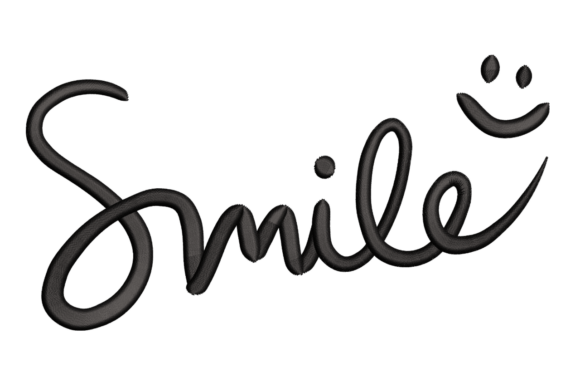
The moment you open the digital embroidery file, Smile Script reads like a breath of air—fluid, unhurried, and quietly confident. The word “Smile” flows in a single, connected script line, with subtle upward lift at the terminals. That tiny 😊 accent? It’s not tacked on—it’s anchored into the descender of the “l”, giving visual rhythm without breaking continuity. There’s no heavy shadowing, no excessive fill stitches, no decorative flourishes that would snag or distort on knit fabric. This is minimal with intention—not minimalism for its own sake, but minimalism built for sweatshirt embroidery.
Mood-wise, it lands squarely between playful and serene. Not childish, not corporate. Not overly feminine, not gender-neutral by default—it simply feels human. On a charcoal French terry hoodie? Calm and grounded. On a blush heather crewneck? Softly uplifting. On oatmeal linen-blend loungewear? Thoughtfully rustic. That versatility is rare—and valuable—for a small shop product.
How It Performs on Real Boutique Apparel
We tested Smile Script across five garment types: classic unisex sweatshirts, oversized hoodies, cropped pullovers, pastel-dyed fleece jackets, and heavyweight seasonal knits. Every time, placement mattered—but the design adapted gracefully.
- Chest placement (standard 3.5"–4.5" width): Ideal. The script’s natural arc mirrors the chest curve. No distortion, even on ribbed cuffs or dropped shoulders.
- Sleeve accent (inner bicep, ~2.75"): Works beautifully at reduced scale—retains legibility thanks to clean letterforms and intentional spacing. Avoid going smaller than 2.25"; the smiley face loses definition.
- Back design (centered, ~6"): Expands with elegance. The flow gains presence without feeling loud—perfect for lifestyle photography where subtlety reads as sophistication.
- Dark fabric: Pair with high-contrast thread—ecru, soft white, or pale gold. The stitch density is moderate, so it lies flat without puffing or shadowing.
- Pastel & light fabrics: Deep navy or charcoal thread adds grounded contrast. Avoid matching thread too closely—it fades into the background and loses its emotional punch.
Practical Designer Considerations You Can’t Skip
This isn’t just about aesthetics—it’s about commercial embroidery viability. Here’s what I watched closely during sampling:
Stitch density is well-balanced—not so sparse it looks unfinished, not so dense it compromises fabric drape or increases thread breakage. On midweight sweatshirts, standard cutaway stabilizer (2-oz) gave crisp results. For lightweight fleece or brushed cotton, we added a light tear-away topper—no puckering, no shifting.
Fabric texture matters more than most realize. On tightly woven French terry, Smile Script held its shape cleanly. On looser-knit vintage-style fleece, we reduced tension slightly and slowed the machine speed by 15%. The result? Still smooth, still expressive—just more forgiving.
Hoop size wasn’t restrictive—we ran it comfortably in a 4"x4" hoop, which keeps setup efficient for batch production. But if your machine supports larger hoops, centering becomes even more intuitive for back placements.
Washing durability? After three gentle cycles (cold wash, low tumble dry), no fraying, no loosening, no color bleed. That speaks to thoughtful underlay and secure jump stitches—critical for a handmade product customers invest in.
Why Smile Script Strengthens Your Boutique Brand Identity
In a sea of algorithm-driven listings and fast-fashion copycats, Smile Script does something quietly powerful: it invites pause. Not because it shouts, but because it breathes. That makes it ideal for boutique brand storytelling—especially when paired with intentional photography: soft natural light, textured backgrounds, hands holding mugs or sketchbooks, slow-motion fabric movement.
For Etsy sellers, it’s a standout in search results for “positive embroidery,” “script sweatshirt design,” or “minimalist hoodie design.” It’s not oversaturated. It doesn’t compete with trending fonts—it occupies its own gentle lane.
And for customer trust? Subtle cues matter. When someone sees Smile Script rendered cleanly on a garment tag mockup or printable mockup, they subconsciously register care—care in spacing, care in proportion, care in how joy is translated into stitch. That builds perceived value far beyond the base price of the sweatshirt.
Final Thoughts for Creative Entrepreneurs
Smile Script isn’t flashy—but it’s memorable. It won’t dominate a lookbook, but it’ll linger in memory after someone wears it out for coffee or walks their dog on a crisp morning. That’s the quiet power of well-executed inspirational design: it meets people where they are, then gently lifts them.
If you’re curating design assets for a growing apparel line—or launching your first custom apparel collection—Smile Script earns its place not as filler, but as foundation. It pairs effortlessly with hand-lettered tags, minimalist packaging, and organic social content. It supports your voice instead of competing with it.
Before full production, always verify your embroidery file includes recommended thread colors, confirm hoop size compatibility with your machine, and test on your exact fabric blend. Small details make the difference between “nice” and “unforgettable”—and Smile Script, in the right hands, lands firmly in the latter.