Good Ideas Start with Coffee Embroidery
A Designer’s Real-World Review for Small Business Merchandise
As an embroidery designer who’s digitized and stitched over 2,400 commercial projects—from café aprons to boutique tote bags—I approach every new machine embroidery design with two questions: “Does it translate professionally at scale?” and “Will it hold up across real business use cases?” When I first saw Good Ideas Start with Coffee Embroidery, my instinct was immediate: this isn’t just a decorative motif—it’s a brand-ready statement. The title alone signals warmth, creativity, and approachability—qualities small businesses in the Work category (creative studios, bakeries, florists, pet brands, indie bookshops) lean into daily.
First Impression: Friendly, Modern, and Intentionally Aesthetic
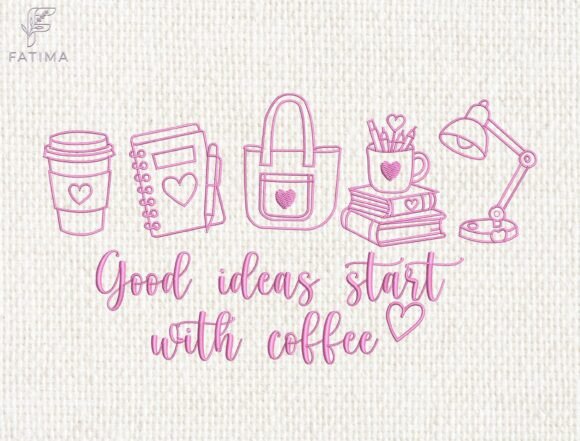
The description—“Fuel your creativity and workspace with this charming Good Ideas Start with Coffee Embroidery Design ☕📖🕯️✨”—tells me this is curated, not cluttered. Those icons suggest layered lifestyle resonance without visual noise. As a designer, I read that as intentional minimalism: clean line work, balanced negative space, and typographic rhythm that leans modern but avoids sterile minimalism. It feels handmade—not rough or unpolished, but human-scaled and warm. That’s gold for small business owners who want their custom apparel and embroidered patch assets to feel authentic, not stock.
Where Good Ideas Start with Coffee Embroidery Shines in Business Use
This design excels where personality meets practicality:
- Staff uniforms & aprons: Perfect as a left-chest accent on canvas aprons or linen-blend work shirts—small enough to read clearly, large enough to convey brand voice.
- Caps & beanies: Works beautifully on structured front panels when sized to 2.5”–3” wide—no crowding, no lost detail in the coffee cup or candle icon.
- Tote bag design: Scales elegantly to 4”–5” on natural cotton or canvas totem bags—ideal for customer gifts, pop-up events, or retail packaging accents.
- Branded patches: Translates cleanly into woven or embroidered patch format for sew-on or iron-on application—great for loyalty programs, team swag, or Etsy seller packaging.
- Product labels & packaging: When stitched onto fabric tags, kraft paper sleeves, or reusable pouches, it elevates handmade product perception without shouting.
For Etsy sellers and craft businesses, Good Ideas Start with Coffee Embroidery bridges aesthetic cohesion and commercial clarity—it doesn’t distract from the product; it quietly reinforces why customers connect with the brand’s story.
Use With Care: Critical Considerations for Production
Even strong designs have boundaries—and respecting them ensures your finished product looks intentional, not compromised:
- Avoid under 1.75” width on curved surfaces (like cap fronts or sleeve cuffs)—fine lettering and icon details may blur or lose definition.
- Test contrast on dark uniforms—if using light thread on navy or charcoal fabric, confirm readability at arm’s length. Black-on-cream or navy-on-ecru often reads stronger than white-on-black.
- Beware high stitch density on textured fabric—burlap, heavy linen, or looped terry can swallow fine outlines. Add lightweight cutaway stabilizer to preserve crispness.
- Don’t skip the wash test—especially for aprons or staff wear. Run a sample through 3–5 cycles before bulk production to verify thread security and colorfastness.
Brand Identity Impact: More Than Just a Motif
Good Ideas Start with Coffee Embroidery does subtle but powerful identity work. It positions a small business as thoughtful, grounded, and creatively confident—not generic or trend-chasing. When repeated across staff aprons, tote bags, and packaging, it builds visual consistency that customers subconsciously trust. That repetition also lifts perceived value: a hand-embroidered tote with this design reads more premium than screen-printed alternatives. For handmade brands, it signals care in execution—not just messaging. And for merch creators, it sparks engagement: customers photograph it, tag the shop, and associate the phrase with authenticity. That’s organic brand reinforcement you can’t buy with ads.
Practical Embroidery Designer Notes You Can’t Skip
Before stitching your first batch, run these checks:
- Test in black and white first—confirm legibility of spacing between “Good,” “Ideas,” “Start,” and “Coffee.” Tight kerning can collapse at small sizes.
- Verify small-patch viability—resize to 1.8” wide and stitch a sample. Does the candle flame or book spine retain shape? If not, request a simplified variant or adjust density.
- Review thread color contrast—match thread to your brand palette, but prioritize readability over exact hue matching.
- Inspect spacing around icons—those tiny ☕📖🕯️✨ need breathing room. Crowded icons read as one blob—not charm.
- Confirm hoop size compatibility—most versions will fit standard 4x4 hoops, but double-check before loading.
- Test on your actual fabric—not just stabilizer swatches. Denim behaves differently than duck canvas.
- Use appropriate stabilizer—cutaway for knits, tear-away for stable wovens, mesh for lightweight linens.
- Create a printable mockup for client approval—show it on apron, cap, and tote contexts so stakeholders visualize real-world use.
- Compare beside other design assets—does it harmonize with your logo, typography, and packaging system?
- Confirm commercial licensing—since this is intended for small business merch, commercial embroidery, and digital embroidery file resale, ensure your license permits those uses. When in doubt, contact the creator directly.
Remember: Good Ideas Start with Coffee Embroidery isn’t just about caffeine—it’s about intentionality. In a market flooded with generic quotes and clipart motifs, this design earns its place on your most visible branded items because it balances warmth with precision, charm with clarity, and aesthetic appeal with functional embroidery intelligence. Use it well—and let your best ideas brew.